This article provides an in-depth comparison of two major players in the financial hosting industry: ForexVPS and Beeks Financial Cloud. Despite both offering trading infrastructure, their fundamental approaches differ significantly.
ForexVPS is a specialized provider, dominating the market by focusing intensely on the needs of retail and professional algorithmic traders. Its strategy centers on accessibility, ample resources, and bespoke trader-focused software tools. In contrast, Beeks Financial Cloud is an enormous institutional infrastructure company, listed on the London Stock Exchange. Its retail Forex Virtual Private Server (VPS) services are just a small component of a massive portfolio that primarily caters to Tier-1 financial institutions, banks, and exchanges.
- Beeks Financial Cloud is an institutional provider that charges a premium for connectivity while offering lean hardware specs to retail clients.
- ForexVPS offers generous hardware allocations, including double the CPU cores and significantly more RAM than the competitor’s equivalent plans.
- ForexVPS provides better overall value for the retail trader through a wider network of broker-optimized locations and a more accessible, trader-centric support team.
What is ForexVPS?
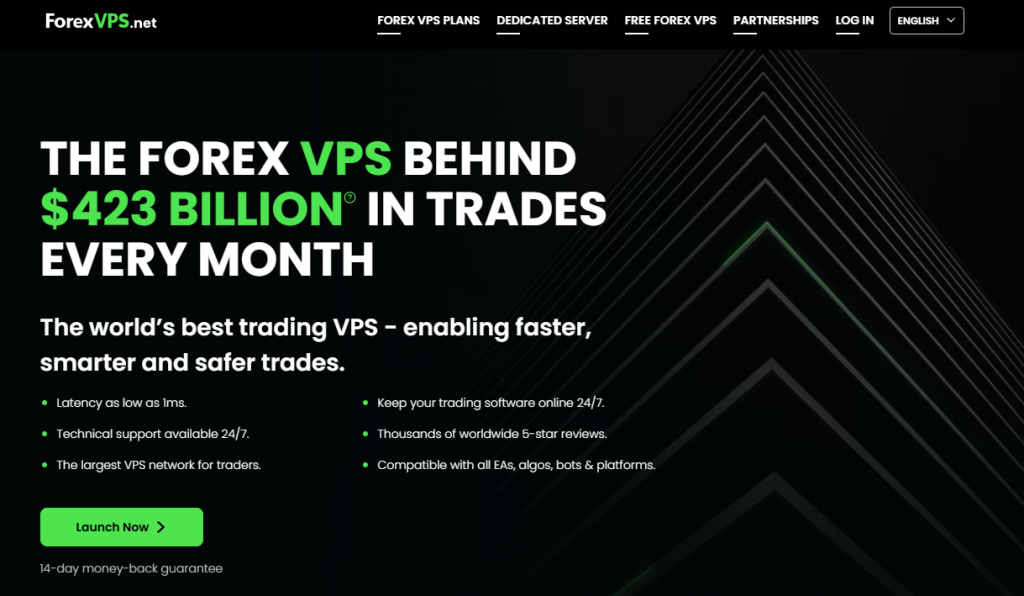
ForexVPS is a leading example of specialized infrastructure, explicitly engineered to support the 24/5, decentralized environment of the retail forex market. The company’s core mission is to eliminate the technical obstacles that undermine algorithmic trading performance, and its entire service delivery model is therefore built around the unique requirements of traders.
In contrast to standard hosting companies that adapt generic web servers for trading—a practice that often causes resource conflicts and inconsistent latency—ForexVPS optimizes its virtualization layer. This optimization specifically addresses the high Input/Output (I/O) bursts and single-threaded CPU demands that are typical of trading platforms.
What is Beeks Financial Cloud?

Beeks Financial Cloud (Beeks) is a big company in the financial markets, like “heavy industrial machinery.” The company, based in the United Kingdom and listed on the London Stock Exchange (LSE: BKS), evolved from being a retail VPS provider (called BeeksFX) to a large company that offers Infrastructure-as-a-Service (IaaS).
Their current operational focus is heavily weighted toward the institutional sector, providing Financial Cloud services to banks, forex brokers, crypto exchanges, and payment processors.
Beeks’ primary value proposition is offering on-demand, low-latency compute, connectivity, and advanced analytics for institutional capital markets. Its core business revolves around high-value enterprise solutions
ForexVPS vs Beeks Financial Cloud: Comparison at a Glance
This comparison chart gives a direct look at the technical details of both Forex VPS server providers to show how their offers are different. The main point is the basic difference in their method: ForexVPS aims to give individual traders the most resources and flexibility. Beeks, which costs more, focuses on high-level connectivity for big financial firms, which means stricter limits on resources.
Comparative Analysis Table
| Feature / Criteria | ForexVPS | Beeks Financial Cloud |
|---|---|---|
| Primary Focus | Specialized Retail & Pro Trading | Institutional IaaS |
| Data Center Proximity | Broker-Centric 22+ locations chosen to minimize latency to a vast array of global brokers. | Exchange-Centric 18 locations focused on major liquidity hubs (NY4, LD4, CME). |
| Average Latency | 1ms – 5ms through colocation. | Not specified |
| CPU Hardware & Cores | Base plans start at 2 CPU Cores, scaling to 6+. | Base retail plans start with 1 vCPU |
| Storage | Base plans start at 100GB SSD, scaling to 200GB. | Base plans start at 30GB SSD, scaling to 75GB. |
| RAM | Base plan offers 4GB RAM. | Base plan offers 2.56GB RAM. |
| Uptime (SLA) | 100% Uptime Guarantee | 99.9% – 99.99% |
| Multiple Server Locations | 22+ global locations across major financial centers for optimal connectivity. | 18 global locations focused on institutional trading hubs. |
| Ultra Low Latency | Optimized for ultra low latency with proximity to brokers, latency checkers, and network tuning for fast trade execution. | Ultra low latency infrastructure with direct connections to exchanges and financial markets. |
| DDoS Protection | Advanced DDoS protection, firewalls, and security protocols to safeguard trading environments. | DDoS protection and enterprise-grade security measures for institutional clients. |
ForexVPS vs Beeks Financial Cloud: Core Forex VPS Hosting Offerings
Both providers aim to deliver a VPS environment that supports reliable performance for critical trading operations. We’ll compare their core offerings to see which provides the necessary power for modern algorithmic trading.
1. Datacenter Locations and Broker Proximity
The speed of light through fiber optic cable is limited; about 1 millisecond of delay is added for every 100 kilometers of distance. Because of this, the physical closeness of the VPS to the broker’s system is the most important factor in lessening slippage and making sure trades are executed at the price you want.
ForexVPS datacenter locations and broker proximity
ForexVPS uses a shared location strategy designed to cover the scattered nature of the global forex market. Their network covers 22 separate data center locations. This reach is not just limited to the three main financial centers (London, New York, Tokyo). Instead, ForexVPS has set up locations in important regional hubs, including Johannesburg, São Paulo, Mumbai, Dubai, and Zurich.
This is key for traders who use local brokers in growing markets. A trader with a broker hosted in Sao Paulo would have a crippling delay if they had to connect to a Beeks server in New York. ForexVPS fixes this by letting the trader host nearby, achieving very fast connection times (less than a millisecond) even in markets that aren’t the biggest.
ForexVPS openly shares a complete Broker Latency List. This tool lets a trader look up their specific broker (e.g., IC Markets, Pepperstone, Exness) and instantly find the best data center location to get a delay of less than 1ms.
Beeks Financial Cloud datacenter locations and broker proximity
Beeks Financial Cloud focuses on a Liquidity Hub strategy, putting its infrastructure in about 9 to 18 main financial centers. Beeks partners with commercial network services to provide direct connectivity to major broker infrastructure, ensuring optimized connections for Forex trading. They have a huge presence inside the Equinix NY4 (New York) and Equinix LD4 (London) buildings, which serve as the main centers for electronic trading in North America and Europe.
Beeks’ location strategy is driven by the needs of exchanges and large-scale liquidity providers. Their facilities in CME Aurora (Chicago) and TY3 (Tokyo) are set up to directly serve the futures and stock markets.
While Beeks is very strong in these major centers, their coverage isn’t as detailed as ForexVPS’s. For an individual trader whose broker might be in a secondary hub (e.g., a specific data center in Cyprus or Sydney that is not an Equinix location), Beeks might not offer a local option. This forces data to travel over the public internet for longer distances, increasing delays.
Summary: Beeks is better for traders focused only on connecting to major exchanges (like CME Futures) where they have a direct, physical connection to major broker infrastructure. However, ForexVPS offers better flexibility for the global forex trader, giving optimized, fast connection options for a much wider range of brokers and places.
Hardware (CPU, Storage, RAM)
The performance of an Expert Advisor (EA) is directly constrained by the hardware resources available to it. MetaTrader 4 (MT4), in particular, is a 32-bit, single-threaded application. This means it cannot use multiple CPU cores for a single chart’s processing; it relies entirely on the raw speed of a single core. Conversely, running multiple MT4 terminals simultaneously requires multiple cores and substantial RAM to prevent system thrashing.
ForexVPS Hardware
ForexVPS has structured its hardware allocations to specifically address the resource hunger of modern trading stacks.
- RAM Allocation: The entry-level Core plan provides 4GB of RAM. This is a critical threshold. A modern Windows Server OS (2016 or 2022) consumes nearly 1.5GB to 2GB just to idle. With 4GB, a trader has ample overhead to run 2-4 MT4 terminals laden with complex indicators without exhausting physical memory. The hardware is not just optimized for running MT4 and MT5 trading platforms, ensuring smooth operation for MT4/MT5. It’s also optimized for other trading platforms, including ThinkorSwim, cTrader, NinjaTrader, and so many more.
- CPU Power: ForexVPS starts its offering with 2 CPU Cores. This multi-core baseline is essential. It allows the operating system to handle background tasks on one core while the trading platform utilizes the other, preventing OS-level interruptions from delaying a trade execution.
- Storage Depth: With 100GB of SSD storage on the base plan, ForexVPS acknowledges that traders accumulate data. Tick data for backtesting, extensive log files, and multiple platform installations consume space rapidly. 100GB ensures that a trader rarely needs to worry about disk cleanup.
The robust hardware supports running multiple trading platforms and automated strategies simultaneously, providing flexibility and reliability for traders who use diverse trading software and rely on continuous, efficient execution of their automated trading systems.
Beeks Financial Cloud Hardware
Beeks Financial Cloud, in contrast, offers hardware specifications that appear lean, reflecting a model where resources are premium commodities.
- RAM Scarcity: The Bronze retail plan offers only 2.56GB (2560MB) of RAM. This is perilously close to the minimum requirement for the operating system alone. If a market spike causes an EA to consume more memory, the system may be forced to use swap memory (writing RAM data to the hard disk), which is orders of magnitude slower and can cause the trading platform to freeze at the exact moment it needs to trade.
- CPU Bottleneck: The Bronze plan includes only 1 vCPU. In a virtualized environment, a single vCPU can easily become overwhelmed by system interrupts or heavy calculation loads, leading to stalled ticks where the platform fails to process incoming market data in real-time.
- Storage Constraints: Offering only 30GB of SSD storage is restrictive. After a Windows Server installation takes 15-20GB, a user is left with less than 10GB for all trading platforms and data. This requires constant maintenance to prevent the disk from filling up, which would crash the server.
Analysis: ForexVPS provides significantly more powerful hardware per dollar. Beeks’ entry-level plans are arguably under-specced for a robust, modern multi-terminal trading environment, necessitating immediate upgrades (and higher costs) for serious traders.
Uptime (SLA)
A server that goes offline during a market movement does not just cost the monthly subscription fee; it costs the potential profit of the missed trades or, worse, prevents the closing of a losing position.
ForexVPS markets a 100% Uptime Guarantee.
- Operational Commitment: This guarantee is a strong statement of confidence in their redundancy protocols. It implies that the entire infrastructure—power, cooling, and network uplink—is architected to N+1 or 2N redundancy standards.
- Financial Accountability: While physical reality dictates that no system is truly failure-proof, the 100% guarantee functions as a strict Service Level Agreement (SLA). If the service drops, ForexVPS is contractually obligated to provide service credits. This aligns the provider’s financial incentives directly with the trader’s uptime.
Beeks Financial Cloud generally operates under a standard commercial SLA range of 99.9% to 99.99%.
- Legal Protections: As an institutional provider, Beeks’ Terms of Service include extensive liability limitation clauses. Users agree to hold harmless the company for hardware malfunctions or software failures. This is standard for B2B infrastructure but offers less reassurance to a retail trader.
- Maintenance Windows: Institutional SLAs often permit scheduled maintenance windows which do not count as downtime. Beeks’ focus on large-scale infrastructure means their maintenance schedules are rigid, whereas ForexVPS may offer more flexibility or live migration capabilities to keep retail VPS instances running during backend work.
Trading Platforms
The Platform refers to the user’s interaction layer—the Operating System (OS) and the ease of deployment.
ForexVPS excels in reducing Time to First Trade.
- Optimized Environment: Servers are deployed with Windows Server 2016, 2019, or 2022, optimized specifically for trading performance (e.g., unnecessary background services disabled).
- Pre-Installation: A major convenience factor is the pre-installation of popular platforms. Users can request servers with MT4 or MT5 already loaded, or use tools to install them quickly.
- Auto-Recovery: The platform includes Auto Startup configurations. If the VPS reboots, the trading terminals launch automatically, ensuring the trader doesn’t need to manually log in to restart their EAs.
Beeks Financial Cloud offers a standard IaaS environment.
- OS Variety: Beeks supports Windows Server 2022 and various Linux distributions. The inclusion of Linux is a significant advantage for developers building custom proprietary trading engines in C++ or Python, a niche ForexVPS focuses on less.
- Manual Setup: The retail VPS is typically a blank slate. The user receives a login and is responsible for downloading, installing, and configuring their trading terminals. While Beeks offers a Managed VPS option for an additional fee or specific broker partners, the default experience requires more technical administration from the user.
ForexVPS vs Beeks Financial Cloud: Additional Features
The biggest difference between the two Forex VPS providers is in the extra software they offer. ForexVPS provides tools to help the trader’s work, while Beeks invests in the network’s connections.
ForexVPS Features
ForexVPS has developed a suite of proprietary tools that solve specific pain points for the retail algorithmic trader.
- Resource Spike Protection: This is perhaps the most critical differentiator for shared VPS environments. During major news events, market data density explodes, causing CPU spikes across all trading terminals. In a standard VPS, this noisy neighbor effect can freeze the server. ForexVPS’s Resource Spike Protection dynamically monitors these loads and allocates burst resources to prevent platform freezes. It acts as a shock absorber for volatility.
- AlgoBuilder: Recognizing the barrier to entry for automation, ForexVPS provides AlgoBuilder. This innovative tool allows traders to construct Expert Advisors using plain-text prompts or a visual interface. It democratizes algorithmic trading, allowing a user to describe a strategy (e.g., Buy when RSI crosses 30) and receive a compiled EA, without needing to learn MQL coding.
- TrackATrader: This integrated analytics suite offers deep insights into trading performance. Unlike standard MT4 reports, TrackATrader analyzes historical market data to identify patterns, suggesting optimizations for the user’s strategy. It serves as a built-in trading journal and performance coach.
- Trace Route Monitoring: This diagnostic utility provides real-time visualization of the network path between the VPS and the broker. It allows traders to audit the quality of their connection and verify that they are receiving the direct routing promised.
Beeks Financial Cloud Features
Beeks’ feature set is engineered for connectivity, security, and fleet management, catering to clients who manage complex, multi-server environments. Beeks offers low latency VPS plans designed for institutional clients, focusing on reduced ping times and proximity to major financial hubs.
- Cross-Connects: Beeks’ flagship capability is the provision of Cross-Connects. This allows a client to run a physical fiber cable from their Beeks rack directly to a liquidity provider (like LMAX, Saxo, or CME) within the data center. This reduces latency to the absolute physical minimum (microseconds). However, this is typically a high-cost add-on reserved for institutional clients and is rarely accessible or necessary for the average retail trader.
- Cloud Management Console: Beeks offers a sophisticated portal for managing compute resources. Users can perform Soft (OS-level) and Hard (power-cycle) reboots, view detailed network load graphs, and manage billing. While powerful, it is a generic infrastructure tool rather than a trading-specific utility.
- Institutional Security: Beeks employs banking-grade security protocols, including ISO27001 and SOC2 certifications. Their firewalls and DDoS mitigation strategies are designed to protect against massive, state-level attacks. For a retail trader, this offers peace of mind regarding data integrity, though it lacks the specific application-level protection of ForexVPS’s Resource Spike Protection.
- Proximity Cloud: For top-tier clients, Beeks offers Proximity Cloud, a fully managed, on-premise private cloud solution. This demonstrates Beeks’ ability to scale up to massive levels, offering dedicated racks and bespoke hardware. While impressive, it is functionally irrelevant to the retail VPS user comparing $30/month plans.
When choosing a VPS solution, traders should compare different VPS providers and consider competitive pricing to ensure they get the best balance of cost, performance, and reliability for their trading needs.
ForexVPS vs Beeks Financial Cloud: Plans and Pricing
A direct comparison of pricing reveals the premium Beeks charges for its institutional brand, versus the value-oriented, resource-heavy approach of ForexVPS.
Plan Comparison
We will compare the entry-level and mid-tier plans
Entry Level Comparison:
- ForexVPS Core: Priced at $35/month. This plan delivers 4GB of RAM, 2 CPU Cores, and 100GB of SSD storage.
- Beeks Bronze: Priced at £31/month. This plan delivers 2.56GB of RAM, 1 vCPU Core, and 30GB of SSD storage.
- Verdict: ForexVPS is not only cheaper in absolute terms but offers vastly superior value. It provides double the CPU power, ~60% more RAM, and more than triple the storage for a lower monthly price.
Mid-Tier Comparison:
- ForexVPS Edge: Priced at $55/month. Includes 6GB RAM, 4 CPU Cores, and 150GB SSD.
- Beeks Silver: Priced at £55/month. Includes 4GB RAM, 2 CPU Cores, and 50GB SSD.
- Verdict: Even at the mid-tier, the disparity widens. ForexVPS offers a robust multi-core environment suitable for serious portfolio trading, whereas the Beeks equivalent is significantly more expensive while still lagging in hardware specifications (offering 2 cores vs 4 cores).
Guarantees, Trials, Free VPS
Money-Back Guarantee:
- ForexVPS offers a transparent 14-day money-back guarantee. This risk-free period is crucial for traders to test latency to their specific broker and verify EA performance.
- Beeks Financial Cloud operates with stricter commercial terms. Cancellations often must be made within 24 hours of purchase to qualify for a refund.9 This policy assumes a business decision has been made, leaving little room for retail experimentation.
Free VPS Programs:
- Both providers leverage broker partnerships. Beeks is the white-label provider for major brokers like FXCM and Pepperstone, where traders meeting volume thresholds (e.g., 5-10 lots/month) get the VPS for free.
- ForexVPS partners with a wide array of brokers including Global Prime, ThinkMarkets, and IC Markets. Traders should always check their broker’s Tools page, as a sponsored VPS is the most cost-effective option. However, purchasing directly from ForexVPS usually grants access to the full feature set (AlgoBuilder, etc.) which might be stripped out of a broker-sponsored white-label version.
ForexVPS vs Beeks Financial Cloud: Support and User Experience
The technical complexity of VPS hosting means that effective support is a vital component of the service.
ForexVPS Reputation
ForexVPS maintains a stellar reputation within the retail trading community, evidenced by a 4.8/5 rating on Trustpilot with thousands of reviews.
- Trader-Centric Support: Support staff are trained not just in Windows Server administration, but in trading specifics. They can assist with MT4 installation, EA configuration, interpreting latency results, and provide help with remote access setup and troubleshooting. This domain expertise reduces the frustration of troubleshooting.
- Accessibility: Live chat is available 24/7 and is noted for low wait times and helpfulness, catering to the retail trader who may need immediate assistance during the Asian or European trading sessions.
Beeks Financial Cloud Reputation
Beeks Financial Cloud’s retail reputation metrics are mixed, with a Trustpilot score of 2.1/5.
- Service Mismatch: This low score likely reflects the friction between retail expectations and institutional service delivery. Retail clients often expect high-touch support, whereas Beeks’ infrastructure-focused support team may expect clients to have a higher degree of technical self-sufficiency.
- Prioritization: As a company serving global banks and exchanges, Beeks must prioritize high-value contracts. This can lead to retail tickets being deprioritized or handled with standardized, rigid responses rather than the personalized problem-solving offered by ForexVPS.
The Final Verdict: ForexVPS vs. Beeks Financial Cloud
The choice between ForexVPS and Beeks Financial Cloud is a choice between a specialized trading partner and a mass-scale infrastructure utility.
ForexVPS emerges as the unequivocal victor for the retail and professional algorithmic trader. By every metric relevant to the individual trader—Price-to-Performance Ratio, Hardware Allocation, Usability, and Support—ForexVPS offers a superior product.
- More Power: You receive double the CPU cores and nearly double the RAM for a lower price, ensuring your EAs have the breathing room to operate during volatility.
- Better Tools: The inclusion of AlgoBuilder, TrackATrader, and Resource Spike Protection creates a complete trading ecosystem that actively aids profitability.
- Global Reach: With 22+ locations, ForexVPS can deliver low latency to a broker in Mumbai or Sao Paulo just as effectively as one in London.
- Trader Assurance: The 100% Uptime Guarantee and 14-day refund policy demonstrate a commitment to the retail user’s success that Beeks’ strict commercial terms do not match.
For the trader seeking a VPS that acts not just as a server, but as a competitive advantage, ForexVPS is the logical, high-performance choice. While Beeks builds the infrastructure for the market makers, ForexVPS builds the weapon for the market takers.