For traders deploying Expert Advisors (EAs), trading bots, and complex algorithms, the Virtual Private Server (VPS) is not merely a server—it is a 24/7 mission control, an execution engine, and a safeguard against the three primary enemies of automated trading: latency, slippage, and downtime.
The decision often comes down to two fundamentally different philosophies: a generic, all-purpose cloud provider, which is often cheaper, versus a specialized, purpose-built trading ecosystem. This report provides a detailed, technical comparison between Kamatera, a respected Infrastructure-as-a-Service (IaaS) provider, and ForexVPS, a specialized service designed exclusively for traders.
- ForexVPS provides a specialized trading ecosystem with guaranteed resources, pre-installed platforms, and proprietary tools like Resource Spike Protection.
- Kamatera offers a complex, unmanaged IaaS environment where the user must configure everything from the CPU type to the firewall rules.
- ForexVPS is the better choice for traders because it removes the burden of server administration and prevents the hidden costs of managing a bare-bones server.
What is ForexVPS?
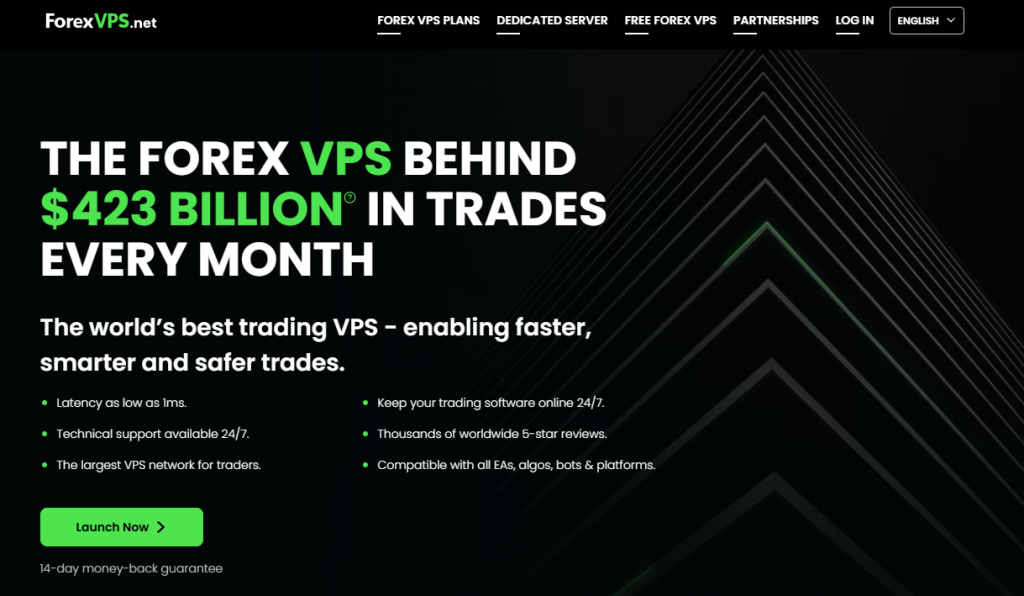
ForexVPS is a premium, managed VPS hosting service exclusively optimized for traders. For more than a decade, the company’s singular focus has been on optimizing forex trading setups to provide unmatched uptime, speed, and reliability.
This specialized approach is built on several key pillars:
- Performance and Infrastructure: The service promises latency as low as 1ms and provides a 100% Uptime Guarantee. This is achieved through a global network of 22 locations strategically placed in key financial hubs.
- Specialized Support: The service is backed by a 24/7 technical support team of over 70 experts. This team is trading-savvy, meaning they are trained to handle trader-specific issues beyond simple server restarts.
- Integrated Trading Ecosystem: All plans include a suite of proprietary, free tools designed specifically for traders, including Resource Spike Protection, AlgoBuilder, and Trackatrader.
This singular focus is the service’s primary strength. Unlike a general-purpose provider that must cater to web hosts, database managers, and app developers, ForexVPS directs its entire research and operational budget toward solving trading-specific problems. This includes managing server loads during extreme market volatility and engineering network paths for minimal latency to specific broker servers—challenges that are unique to the financial trading industry. Subscribing to this service is not just renting server space; it is buying into a managed, optimized FinTech infrastructure.
What is Kamatera?
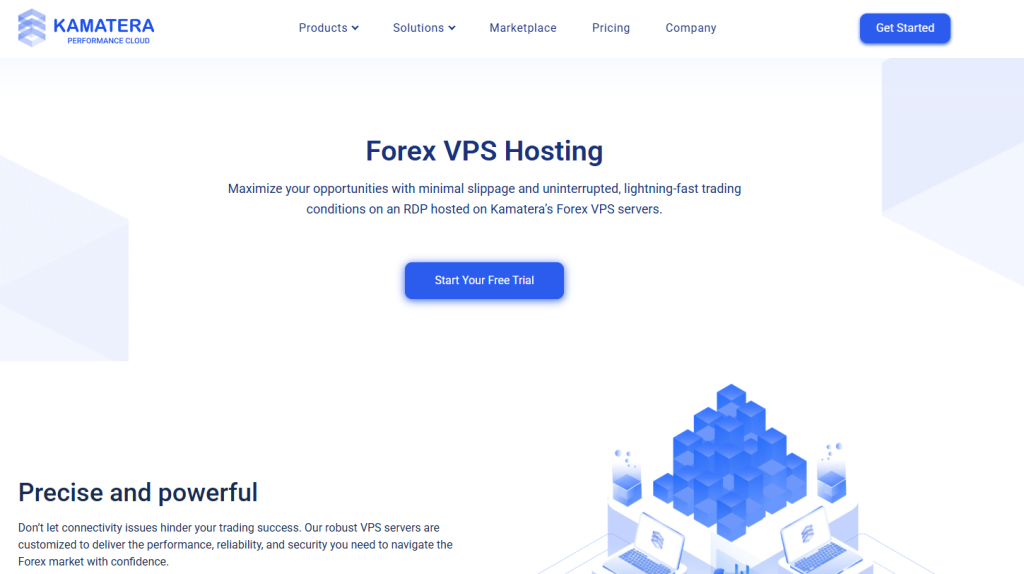
Kamatera is a veteran global cloud provider, founded in 1995, that operates in the Infrastructure-as-a-Service (IaaS) market. Its business model is centered on providing highly customizable, scalable, and unmanaged cloud servers, giving users granular control over their environment.
Kamatera’s services are designed for a broad, technically proficient audience, including startups, SMBs, enterprises, web developers, and app developers. The product portfolio reflects this generalist approach, offering the core building blocks of cloud computing: scalable servers, Cloud Firewalls, Load Balancers, and Block Storage.
While Kamatera does maintain a Forex VPS Hosting landing page, a technical analysis reveals that the features promoted—such as a 99.95% uptime guarantee and flexible scaling—are identical to their standard, generic VPS offerings. There is no evidence of a distinct, separately optimized product or a specialized hosting environment for trading. It is a standard, unmanaged Windows VPS marketed to a trading audience.
This distinction is critical. It signifies that Kamatera’s Forex VPS is a marketing funnel, not a specialized service. The entire burden of optimization—from selecting the correct data center and securing the server to managing system updates and installing all necessary software—falls entirely on the end-user. This includes manual server management and the responsibility of configuring full root access, which can be complex for traders seeking a turnkey solution.
ForexVPS vs Kamatera: Comparison at a Glance
The fundamental differences in philosophy and service delivery are best illustrated by a direct, side-by-side comparison of the metrics that matter most to a trader.
| Feature | ForexVPS (The Specialist) | Kamatera (The Generalist) |
|---|---|---|
| Primary Focus | Specialized VPS for algorithmic traders (EAs, bots) | General-Purpose Cloud Infrastructure (IaaS) for developers & IT |
| Data Center Strategy | Broker Co-Location: 22 server locations in major financial hubs (e.g., Equinix) for broker proximity and ultra-low latency to forex brokers worldwide | General Availability: 24 global data centers for broad, all-purpose access |
| Average Latency | As low as 1ms to major brokers; public latency list available | Not specified for brokers. |
| CPU Hardware | Guaranteed, Dedicated Intel Xeon Cores | Complex Tiers: 4 CPU Types (Availability, Burstable, General, Dedicated). Availability (Type A) is not guaranteed. |
| Storage | High-Speed SSD | High-Speed NVMe SSD |
| RAM | 4GB – 128GB (Guaranteed) | 1GB – 512GB (Varies by CPU type) |
| Uptime (SLA) | 100% Uptime Guarantee (backed by 99.99% SLA) | 99.95% Uptime Guarantee |
| Platform Compatibility | Supports multiple trading platforms, including all major trading platforms such as MetaTrader, cTrader, and NinjaTrader | Supports a wide range of general-purpose applications |
ForexVPS vs Kamatera: Core Forex VPS Hosting Offerings
The at-a-glance table reveals foundational differences in infrastructure and service philosophy. This section explores the practical, real-world implications of these differences for a trader running an automated strategy.
1. Datacenter Locations and Broker Proximity
Kamatera offers an impressive 24 global data center locations. This is an excellent feature for a multinational corporation needing to deploy web applications with global availability. For a Forex trader, however, this approach only presents an illusion of choice that is, in reality, a significant risk.
In trading, there is only one data center location that matters: the one that is physically closest to the broker’s trading server.
- ForexVPS operates 22 locations, but these are not just in big cities. They are strategically chosen and co-located within the exact same premium financial data centers (like Equinix) where the major brokers house their execution servers. By placing servers in major FX liquidity hubs, ForexVPS ensures optimal connectivity and ultra-low latency for traders who need fast access to forex brokers worldwide. This physical proximity—often in the same building—is what allows ForexVPS to achieve latencies as low as 1 millisecond.
- Kamatera’s 24 locations force the trader to become a network engineer. To minimize latency, the trader must first research to find the precise physical address of their broker’s server, then ping all 24 of Kamatera’s locations to determine which is closest. A mistake is easy to make; a trader in Miami might choose Kamatera’s Miami server for low latency, not realizing their broker’s server is in New York (Equinix NY4), instantly adding 30ms+ of slippage-inducing latency.
ForexVPS has already done this engineering work for the trader. The company provides a public Broker Latency List that explicitly shows the latency from its servers to major brokers. For example, connections to brokers like IC Markets and Pepperstone from the ForexVPS New York server show a latency of just 1ms. This transparency removes the guesswork and a major point of failure, ensuring the trader is on the optimal, lowest-latency connection from day one.
2. Hardware (CPU, Storage, RAM)
For an EA to function correctly, it needs 100% of its allocated resources to be available 100% of the time, especially during high-volume market events.
ForexVPS builds its plans on this principle, offering simple, clear, and guaranteed resource allocations. The entry-level “Core” plan, for example, provides 2 CPU cores, 4 GB RAM, and 100 GB SSD storage. Critically, all plans include dedicated resources, with no “noisy neighbors” from resource sharing.
Kamatera’s hardware model is far more complex and introduces a critical trap for non-technical users. It offers four different CPU types:
- Type A (Availability): These are non-dedicated vCPUs with no resources guaranteed. This is fundamentally unsuitable for an EA, which could be resource-starved and freeze during a volatility spike simply because another user on the same physical machine is running a demanding process.
- Type T (Burstable): These Burstable CPUs come with a significant financial risk. If an EA exceeds a certain average CPU usage—a common occurrence during major news events—the user will be extra charged. This creates a high-risk scenario where market volatility could lead to a large, unexpected bill.
- Type B (General Purpose) & Type D (Dedicated): These types do offer guaranteed, reserved resources and are the only two suitable for a serious trading application.
This tiered system creates a price deception. Kamatera’s extremely low advertised starting prices are for the unsuitable Type A or financially risky Type T servers. To get a truly comparable, stable, and dedicated server (a Type B or D) that is equivalent to the baseline offering from ForexVPS, a user must select a much more expensive tier, completely eroding Kamatera’s perceived price advantage.
3. Uptime (SLA)
Uptime guarantees are a clear, mathematical measure of risk. Kamatera offers a 99.95% Uptime Guarantee. ForexVPS offers a 100% Uptime Guarantee, which is legally backed by a 99.99% Service Level Agreement (SLA).
Translating these percentages into real-world time reveals the stark difference:
- Kamatera (99.95%): Allows for 0.05% downtime, which equals 4.38 hours (or 263 minutes) of potential downtime per year.
- ForexVPS (99.99%): Allows for 0.01% downtime, which equals 52.6 minutes of potential downtime per year.
For a general web developer, 4.38 hours of downtime in a year might be an acceptable, compensated inconvenience. For a trader, it is a catastrophic financial risk. Four hours of downtime means four hours where EAs are blind, trades are unmanaged, and stops are not being executed, potentially leading to a blown account.
This 210-minute difference in acceptable downtime highlights a fundamental difference in operational philosophy. Kamatera’s 99.95% SLA is a standard legal document designed to define compensation (typically a small service credit) after a failure. ForexVPS’s 100% guarantee is an operational promise aligned with its clients’ needs. Its entire business model is built on serving traders, for whom downtime is unacceptable at any price. This is why its infrastructure is built to Tier IV standards, designed to prevent failure, not just compensate for it after the fact. Uptime directly impacts trading success, as even brief interruptions can affect trade execution and overall profitability.
4. Platform
This section compares the “Time-to-Trade”—the user experience from the moment of purchase to placing the first trade.
ForexVPS:
- A trader purchases a plan (e.g., “Core”).
- The VPS is provisioned within 15 minutes.
- The trader receives login details, connects via standard Remote Desktop (RDP), and finds a fully optimized Windows Server (2016/19/22) already running, secured, and optimized for trading platforms.
- The trader opens the browser, downloads their broker’s MT4/MT5 platform, and installs it.
- There’s also support for other trading platforms, including TradingView, NinjaTrader, cTrader, and more.
- Time-to-Trade: Under 20 minutes.
- The entire setup process is user-friendly, with an intuitive interface and simplified server management designed for traders of all experience levels. Responsive 24/7 customer support is available to assist with any technical issues or trading-specific questions, ensuring a seamless hosting environment.
Kamatera:
- A trader purchases a plan.
- They must log into the complex Cloud Management Console.
- Step 1: Create Server. The user must choose from 24 zones.
- Step 2: Choose OS. The user must select “Windows Server” from over 100+ images.
- Step 3: Configure License. The user must add the Windows Server license, which is a separate, additional monthly cost.
- Step 4: Configure Hardware. The user must navigate the complex CPU Types (A, B, T, or D?) and select RAM/SSD sizes.
- Step 5: Configure Networking. The user must configure their own network and firewall rules.
- Step 6: Create Server. The server is provisioned.
- Step 7: Connect. The user must find their IP and manually configure their RDP connection.
- Step 8: Secure Server. The user is now on a blank, un-updated, and un-secured Windows Server. They are now responsible for running all Windows Updates, hardening security settings, and configuring the OS.
- Step 9: Install Software. The user can now download and install MT4.
- Time-to-Trade: 2-3 hours, if the trader is also a competent IT system administrator.
- The process lacks a user-friendly interface and offers limited customer support for trading-specific issues, making server management and troubleshooting more challenging for traders.
Kamatera’s platform is not a service; it is a project that the trader is now responsible for building and, critically, maintaining. This creates a technical debt, forcing the trader to become a part-time sysadmin responsible for all patching and OS-level troubleshooting—a dangerous distraction from their primary job of trading.
ForexVPS vs Kamatera: Additional Features
This section highlights the most significant difference between the two providers. ForexVPS’s features are active benefits that directly enhance trading performance. Kamatera’s features are complex tools that require an IT expert to manage.
ForexVPS Features
ForexVPS provides a comprehensive ecosystem of proprietary tools, included free with every plan, designed to solve specific trading problems.
- Resource Spike Protection: This is a game-changing, proactive feature. During high-impact news events (like Non-Farm Payrolls), market volatility causes EAs to dramatically increase their calculations, consuming high CPU and RAM. On a normal VPS, this leads to a freeze or crash. ForexVPS automatically allocates additional server resources during these peaks to prevent any disruption. It acts as an intelligent circuit breaker to keep trades stable when it matters most.
- AlgoBuilder: This tool is a massive value-add, transforming the provider from a host to a strategic partner. AlgoBuilder is a no-code, AI-powered platform that allows traders to build, backtest, and deploy their own EAs using simple text prompts, with no coding knowledge required.
- Trackatrader: This is a full-featured, professional trading analytics dashboard. It connects to the trader’s platform and provides deep insights into performance, helping them analyze and optimize their EA’s strategy.
- Trace Route Monitoring: This built-in diagnostic tool allows traders to see the exact network path and ping times from their VPS to their broker’s server, supporting low-latency connectivity to major forex brokers and helping to identify and troubleshoot any latency issues.
These features create a complete, closed-loop algorithmic trading lifecycle for professional traders seeking profitable trades. A trader can:
- Build a strategy (AlgoBuilder).
- Host it on a stable platform (The VPS).
- Protect it during crises (Resource Spike Protection).
- Analyze and Improve its performance (Trackatrader).
- Diagnose its connection (Trace Route Monitoring).
Kamatera, as a generic provider, only offers a non-optimized, DIY version of Step 2.
Kamatera Features
Kamatera’s features are powerful, but they are the wrong tools for this job. For a trader, they are not benefits, but liabilities. Unlike other forex vps hosting providers, such as ForexVPS, Kamatera does not offer a specialized forex vps designed specifically for trading needs, which can be a significant drawback for those seeking optimized performance and reliability.
- Cloud Management Console: This is a complex, enterprise-grade dashboard designed for an IT team to manage hundreds of servers, create clones, and map complex networks. For a trader needing one server, this interface is overwhelming, confusing, and filled with irrelevant options. This complexity can be especially challenging for beginner traders who may find it difficult to navigate and configure the platform effectively.
- Cloud Firewalls: This is not a simple “on/off” switch. Kamatera’s firewalls are powerful, configurable tools that require the user to create and manage their own rulesets. A non-technical trader can easily misconfigure this, blocking their RDP access or, worse, their MT4 platform’s connection to the broker. In contrast, ForexVPS provides “Cyber Security Protection” as a managed service.
- Load Balancers: This feature is a prime example of the “generalist” mismatch. A load balancer is a tool for high-traffic websites to distribute incoming requests across multiple servers. It has zero application for a trader running a single MT4 instance. It is a feature a trader would be (indirectly) paying for in the platform’s R&D but would never use.
For a trader, whose goal is to reduce variables and focus on strategy, Kamatera’s platform does the opposite. It adds variables and complexity, creating a steep learning curve and multiple new points of potential, self-inflicted failure.
ForexVPS vs Kamatera: Plans and Pricing
This section deconstructs the Total Cost of Ownership (TCO) to reveal that Kamatera’s cheaper sticker price is a dangerous illusion for this use case.
Plan Comparison
ForexVPS: Offers simple, all-inclusive, predictable pricing. Each ForexVPS plan is designed to address a wide range of trading needs, ensuring traders have a reliable, secure, and high-performance trading environment tailored for optimal results.
- Core Plan: $28/month (when paid yearly).
- What this includes: 2 guaranteed CPU cores, 4 GB RAM, 100 GB SSD, a Windows Server license, 100% Uptime Guarantee, 24/7 “trading-savvy” support, automated backups, Resource Spike Protection, AlgoBuilder, and Trackatrader.
Kamatera: Offers complex, unbundled, a la carte pricing. Their forex vps service may require additional configuration and add-ons to fully meet specific trading needs, which can impact both cost and the overall trading environment.
- Sticker Price Hardware: A 2 vCPU, 4GB RAM, 40GB SSD server is advertised at $19/month.
- The “Hidden Costs” (Total Cost of Ownership):
- CPU Type: The $19 price is for a non-guaranteed Type A vCPU. A stable, guaranteed Type B or D server will cost significantly more.
- + Windows Server License: The $19 price is for a Linux server. A Windows Server license is a separate, additional monthly fee. Kamatera’s own pricing calculator shows Windows plans starting at $25 (for a much smaller server), implying the license fee is a substantial cost.
- + Daily Backups: This is an optional add-on with an extra monthly fee. This is included as standard with ForexVPS.
- + Managed Services: The platform is unmanaged. If a trader is not an IT expert, they must purchase the “Managed Service” add-on for an additional monthly fee to have Kamatera’s team handle OS-level issues.
When these a la carte items are bundled to create a truly comparable managed, secure, and backed-up Windows server, Kamatera’s TCO is likely to be double or triple that of the all-inclusive ForexVPS plan. Kamatera is not the “cheap” option; it is the “deceptively expensive” one.
Money Back Guarantee, Trials, Free VPS
Kamatera: Offers a 30-day free trial, but it is capped at a $100 credit and requires a credit card to begin. If a user’s configuration exceeds this cap, they are charged.60 This is a standard marketing tool to get users onto their billing platform.
ForexVPS: Offers a straightforward 14-day money-back guarantee on its VPS plans.
More importantly, ForexVPS has an offer that a generic provider can never match: a Free VPS. This is not a limited-time trial. It is a B2B partnership model where top brokers like IC Markets and SwitchMarkets pay ForexVPS to provide a free, high-quality VPS to their clients who meet certain trading volumes.
This Free VPS model from ForexVPS is the ultimate external validation. Brokers sponsor this service because they know that a trader running on a stable, low-latency ForexVPS server will experience fewer technical issues, be more likely to trade successfully, and will generate more consistent trading volume.
Free forex VPS services aren’t something brokers just partner with any VPS provider to offer. So, this broker’s financial sponsorship is a testament to the service’s quality and reliability, embedded deep within the trading industry.
ForexVPS vs Kamatera: Customer Support and User Experience
A server is only a piece of hardware until it breaks. When an EA is offline, and money is on the line, the quality and type of support a trader receives is paramount.
ForexVPS Reputation
ForexVPS has a stellar reputation in the trading community, with a 4.8/5-star rating on Trustpilot from over 5,000 reviews.
The praise is not just for being fast, but for its trading-savvy support that understands trader-specific issues. This domain-specific expertise is invaluable. ForexVPS is also compatible with Interactive Brokers and other major trading platforms, supporting professional traders who require reliable, multi-platform access with high performance and security.
Consider this scenario:
- Trader: “My EA isn’t placing trades.”
- ForexVPS Support: “I see you’re running MT4. Let’s check the ‘Experts’ and ‘Journal’ tabs for an error. It looks like a DLL import is not allowed. Please check your ‘Options’ settings. While we’re at it, let’s run a trace route to check your connection to the broker.”
This is a partner who can troubleshoot the entire trading stack, from the network layer to the platform itself.
Kamatera Reputation
Kamatera’s reputation is mixed and perfectly illustrates its userbase.
- The Good (from Tech Users): Reviews praise and recommend it for more experienced website owners or developers. These positive reviews confirm it is a tool for tech experts.
- The Bad (from Non-Tech Users): Reviews are filled with warnings: “Setup can be difficult, and may require support”, “requires knowledge”, and “Meh control panel, feels like something from 10 years ago”.
Now, consider the same scenario:
- Trader: “My EA isn’t placing trades.”
- Kamatera Support: “We have pinged your server. It is online. The OS is responding. CPU and RAM are within limits. This appears to be an issue with your third-party ‘MetaTrader’ application. We cannot provide support for software we do not license. Please contact the software vendor.”
This is a gatekeeper who can only confirm the hardware is “on.” For a trader in crisis, this support is useless.
The Final Verdict: ForexVPS vs. Kamatera
The choice between ForexVPS and Kamatera is not a like-for-like comparison between two VPS providers. It is a decision between a fully managed, high-performance trading service and a DIY box of unmanaged IT parts.
Kamatera is a powerful and respected IaaS platform. For a technical user—a developer, an IT department, or a corporation—who needs total, granular control to build and manage a complex cloud application from the ground up, it is an excellent choice.
For a Forex trader, this “flexibility” is a bug, not a feature. It is a burden that introduces unnecessary complexity, significant hidden Total Cost of Ownership (TCO), and the constant, time-consuming risk of misconfiguration. A trader on Kamatera must work on their server, whereas a trader on ForexVPS can work from their server.
ForexVPS is the clear, unequivocal choice for any trader using automated strategies. It is an optimized ecosystem that:
- Removes variables by guaranteeing resources and 100% uptime.
- Solves trading-specific problems like latency (via broker co-location) and volatility freezes (via Resource Spike Protection).
- Adds value beyond hosting with an integrated suite of professional tools like AlgoBuilder and Trackatrader.
Ultimately, Kamatera sells server space. ForexVPS sells a solution that allows a trader to focus on their one and only job: trading. Traders seeking an optimized, reliable, and fully supported environment can explore the all-inclusive plans offered by ForexVPS.