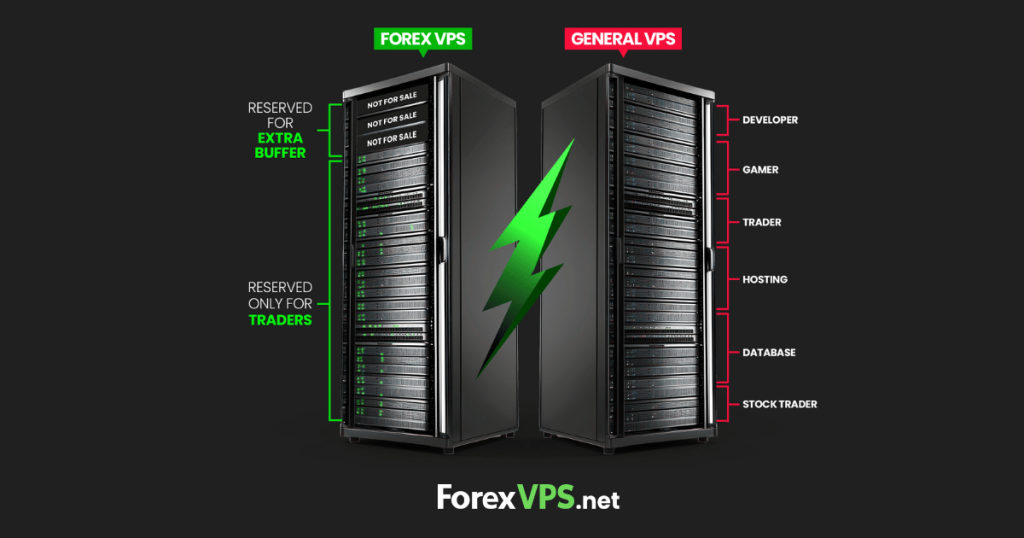
- The major difference between a Forex VPS and a regular VPS is the strategic server location and optimization for trading. Forex VPS servers are placed near major financial hubs and broker data centers to ensure ultra-low latency and faster trade execution, which is critical for trading success.
- Other differences include resource allocation, specialized trading features, dedicated support with Forex expertise, and enhanced security measures tailored specifically for Forex trading, whereas regular VPS services are more general-purpose and not optimized for the fast-paced financial markets.
- Traders should choose a Forex VPS if they require reliable, uninterrupted trading with minimal latency, especially when using automated strategies or Expert Advisors. However, if trading speed and continuous operation are less critical, and manual trading is preferred, a regular VPS may suffice.
Virtual Private Servers (VPS) provide continuous, remote access to trading software. However, not all VPS services are designed with forex trading in mind. This article will clarify the differences between a Forex VPS and a regular VPS, highlighting why choosing the right type can impact your trading performance, execution speed, and overall experience.
What is a Forex VPS?
A Forex VPS (Virtual Private Server) is a specially designed virtual server that provides forex traders with a stable, secure, and low-latency environment to keep their trading platforms running smoothly around the clock, even when their personal computer is off.
A Forex VPS ensures that automated trading strategies and Expert Advisors (EAs) operate without interruption, reduces delays by hosting servers close to major financial centers and broker servers, and offers dedicated resources optimized for the best trading performance. This setup helps speed up trade execution, minimize slippage, and boost overall trading reliability and security.
We go in-depth into what a Forex VPS is here: What is a Forex VPS and How Does it Help Your Trading?
What is a Regular VPS?
A Regular VPS (Virtual Private Server) is a virtualized server environment designed to serve a wide range of general hosting needs. Unlike a Forex VPS, which is tailored specifically for trading activities, a regular VPS provides flexible hosting solutions for various purposes, such as hosting websites, running applications, managing databases, or supporting development environments.
Regular VPS hosting offers users dedicated resources like CPU, RAM, and storage within a shared physical server, allowing for isolated and customizable server environments. These servers are typically located in data centers around the world, but are not specifically positioned to optimize latency for financial trading.
What are the Differences Between a Forex VPS and a Regular VPS?
Here are some of the differences between a forex VPS and a regular VPS:
| Feature | Regular VPS | Forex VPS |
|---|---|---|
| Purpose | General-purpose hosting for various applications. | Specifically designed for forex trading, ensuring optimal performance. |
| Server Location | Servers are distributed globally, often near major data centers, without a specific focus on trading. | Strategically placed near brokers and trading exchanges to minimize latency. |
| Latency | Higher latency, not optimized for trading speed. | Ultra-low latency for faster trade execution. |
| Resource Allocation | Pooled, often oversold | Dedicated, reservable per application |
| Additional Features | Features are general-purpose and not tailored to trading needs. | Includes trading-specific features like trading analytics and often comes with MetaTrader pre-installed or optimized for it. |
| Support | Support is general and may not have expertise in trading-specific issues. | Specialized support knowledgeable in trading-related issues. |
| Pricing | Generally more affordable for standard hosting needs. | May be higher due to specialized features and optimizations. |
1. Purpose and Latency Consideration
The biggest difference between a forex VPS and a regular VPS, and perhaps the most significant advantage the former has over the latter, is the strategic positioning of servers. Regular VPS providers tend to have their scattered servers worldwide while concentrating more on areas that make the most business sense to them. For instance, it is normal for a regular VPS provider to have their servers close to Google data centers in all countries because they know that most of their users use Google searches.
Forex VPS providers, on the other hand, have traders at the forefront of their minds when it comes to the placement of their servers. They place their servers close enough to the servers of brokers and trading exchanges worldwide. This way, trading latency is brought to a minimum.
2. Resource Allocation
Forex VPS providers reserve dedicated CPU and RAM per customer where regular VPS providers oversell shared capacity. A regular VPS host might place 1,000 accounts on a server built for 256, betting most customers use under 100MB of RAM at once. According to WebHostMost’s 2026 hosting resource analysis, since 95% of customers use under 100MB RAM consistently, a 3.9x overselling ratio still works. The bet breaks when a traffic spike hits simultaneously.
| Resource Dimension | Regular VPS Providers | Forex VPS Providers |
|---|---|---|
| CPU allocation | Oversold, multiple tenants share physical cores, optimized for core count | Dedicated or lightly shared, optimized for single thread clock speed |
| RAM allocation | Often overcommitted with memory ballooning | Reserved and guaranteed, no overcommitment |
| Storage | Standard SSD, shared I/O throughput | NVMe or high IOPS SSD, tuned for low latency |
| Physical placement | Chosen for general cost and coverage | Chosen for proximity to broker/exchange infrastructure |
| Tenant density per host | High, maximizes provider margin | Low, protects against simultaneous resource contention |
| Uptime/SLA | Typically 99.5% or best effort | Typically 99.9%+ with compensation clauses |
| Support specialization | General IT/hosting support | Trading platform aware support |
As QDE’s 2026 overselling analysis puts it, customers pay for dedicated, isolated resources, and overselling undermines that expectation entirely. That’s exactly why Forex VPS providers avoid the practice on trading-critical infrastructure. Algo trading bots and EAs often spike CPU at the same moment, such as a Non-Farm Payrolls release or a central bank rate decision, because every subscriber’s automated strategy reacts to the same event simultaneously. Provisioning has to assume correlated demand, not random demand, so Forex VPS hosts run fewer tenants per physical server and reserve RAM and CPU cores per account rather than pooling them.
3. Latency
Forex VPS providers measure and guarantee latency in milliseconds; regular VPS providers rarely mention it at all. And when it comes to trading, latency can be the difference between a working strategy in backtests and a losing strategy in live trades. So, when Forex VPS providers share latency figures (as opposed to regular VPS providers), they aren’t just throwing marketing jargon out there with the hope of getting a piece of what’s in your pocket. Rather, they’re telling you how quickly you can expect your trades to execute and how much slippage you’re likely to avoid.
Usually, Forex VPS providers are able to keep their latency low because their servers are hosted in the same locations as your brokers’ servers, or they have some form of cross-connection to your brokers’ servers that helps your trades get executed instantaneously. According to CompareForexBrokers’ execution speed testing, cross-connect setups inside the same data center as a broker’s matching engine average 0.33 milliseconds in LD4 (London) and 0.37 milliseconds in NY4 (New York).
A regular VPS provider may have their server in the same city as your brokers’ servers, but that’s just not enough.
| Latency Dimension | Regular VPS Providers | Forex VPS Providers |
|---|---|---|
| Baseline latency target | Not specified, “good enough” for web hosting | Explicit targets, often sub-1ms to low single digit ms |
| Data center selection | Cost and general geographic coverage | Physical proximity to broker/exchange matching engines |
| Network path | Standard internet routing, multiple hops | Direct peering or cross-connects, minimal hops |
| Jitter and route control | Not actively managed | Actively monitored, rerouted if a path degrades |
| RTT transparency | Not typically disclosed | Often shown live in dashboard or control panel |
| Latency in SLA | Rarely included | Sometimes explicit, tied to compensation if breached |
Retail brokers concentrate their MetaTrader servers in a handful of Equinix facilities: NY4 in Secaucus, LD4 in Slough, and TY3 in Tokyo. A VPS in the same building as the broker’s server reduces round-trip network time to 1 to 5 milliseconds. Move to a different data center in the same city, and that climbs to 5 to 30ms. Land on the wrong continent, and it climbs again to 60-300ms.
4. Uptime
Forex VPS providers build in redundant power and network paths; regular VPS providers typically don’t. A regular VPS going offline for ten minutes is an inconvenience for a website visitor. A forex VPS going offline for ten minutes while an EA holds an open position can produce a real, unrecoverable loss.
Forex VPS providers respond by targeting uptime SLAs of 99.99% or higher, often with compensation clauses if the target is missed. Regular VPS providers are fine with 99.9% SLAs. You may look at these figures and wonder what the difference is. Here’s the difference over a year:
| Uptime SLA | Downtime per Year | Downtime per Month | Downtime per Day |
|---|---|---|---|
| 99% | 3.65 days | 7.2 hours | 14.4 minutes |
| 99.5% | 1.83 days | 3.6 hours | 7.2 minutes |
| 99.9% | 8.76 hours | 43.8 minutes | 1.44 minutes |
| 99.99% | 52.56 minutes | 4.38 minutes | 8.64 seconds |
| 99.999% | 5.26 minutes | 26.3 seconds | 0.86 seconds |
4. Additional Features
A Forex VPS often has features that help improve the trading experience of the user. For instance, ForexVPS (the brand) comes with trading analytics features. Some other VPS brands also have MetaTrader preinstalled. Even those that don’t have the trading platform pre-installed have their servers optimized to run them.
For a regular VPS, though, whatever additional features it has are very likely not going to be specific to trading.
5. Support
The specificity of support that a user will get from a Forex VPS will also be different from what they’ll get from a regular VPS. A Forex VPS support will be trained to handle customers’ questions and issues that cut across trading and the VPS as a tool. For instance, a Forex VPS support service may be able to help troubleshoot an Expert Advisor issue.
Because regular VPS support caters to customers using this VPS for all purposes, specificity may be too much of an ask.
6. Pricing
Pricing is another area where a Forex VPS differs from a regular VPS. Because the focus and optimization of a Forex VPS is for trading, it can be more expensive than a regular VPS.
Forex VPS pricing reflects real infrastructure costs, colocation, dedicated resources, and redundancy, not just brand positioning. Regular VPS providers profit from density: pack more tenants per server, spread hardware cost across more customers, and pass the savings down. Forex VPS providers can’t densify the same way without breaking latency and reliability guarantees.
Colocation inside a tier 1 financial data center like Equinix NY4 costs far more per rack unit than a generic cloud region built for web hosting. Reserved, not pooled, CPU cores mean fewer paying customers per physical server. Redundant power and network paths, required to hit 99.99% uptime SLAs, add hardware cost that a $5/month shared host never has to carry. Entry-level forex VPS plans run $30 to $80 per month, against $5 to $15 per month for comparable general-purpose VPS tiers.
The gap isn’t pure margin. A trader running a scalping EA loses more in a single mistimed fill than the entire annual difference in hosting cost. That’s the calculation forex VPS pricing is built around, not the cost of a website that can tolerate a two-second load time.
Forex VPS vs Regular VPS: Which Should You Choose?
If you want to use the VPS for trading purposes, then a forex VPS is your best bet. It may be a tad more expensive than the regular VPS. However, you get value for your money when you consider how most Forex VPS services have colocated servers in the same data centers that host the servers of brokers and exchanges. This means that the slippage risks are significantly reduced, helping you save money in the long run.
Having said that, not all traders absolutely need a forex VPS. If you’re a swing trader to whom high-speed execution doesn’t matter much, you might not need a forex VPS. And if you’re always there to make your trades physically, you really don’t even need any kind of VPS at all.
How Do You Choose the Right Forex VPS
Selecting the best Forex VPS for your trading needs requires careful consideration of several factors. Here are the key points to evaluate when making your decision:
1. Latency and Server Location
Choose a provider with Forex VPS servers located near your broker’s data center. It’s even better if the provider has a colocated server in the same data center as the broker. Lower latency ensures faster order execution, which is crucial for high-frequency and automated trading strategies.
If you’re unsure whether a VPS has a server close to a data center, contact them and let them clarify the information.
2. Uptime Guarantee
Reliability is essential in trading. Look for VPS providers that offer a 99.99% uptime guarantee or higher to minimize the risk of unexpected downtime, especially if you’re going to be running a trading bot.
3. Resource Allocation
Ensure the VPS has sufficient RAM, CPU power, and bandwidth to handle your trading platform, expert advisors (EAs), and indicators without performance issues. Now, it is hard to say how much computing power your trading bot will need in this blog post. But that’s a question the VPS provider should be able to help you answer.
If you’re unsure, do a trial with them to see how it goes.
4. Customer Support
Customer support is, perhaps, the most important non-technical reason you should choose a Forex VPS or dump one. Forex trading operates 24/5, so round-the-clock customer support is crucial to resolve potential issues swiftly.
Also, don’t settle for less with the support if they’re not offering solutions to your issues.
5. Pricing and Value
Of course, pricing is another huge factor in choosing a Forex VPS. And when it comes to this, we recommend that you not only focus on the numerical values of the various Forex trading VPS providers you’re considering. Instead, focus on the value you’ll get for whatever you pay.
If you subscribe to a cheap VPS with poor support, you’ll likely pay for it in the frustration you get when an issue arises. That’s why you need to make a wholesome comparison of what the providers offer for their prices. Also, read reviews from independent review sources to get an unbiased view of what other users think about each VPS.
Conclusion
Deciding between a Forex VPS and a regular VPS really comes down to what you need as a trader. If you’re actively trading, especially with automated systems or if you need lightning-fast execution and rock-solid reliability, a Forex VPS is designed just for you. It offers servers strategically located close to financial hubs, dedicated resources, and support that truly understands the fast-moving world of forex trading.
On the other hand, if you’re more of a casual or manual trader, a regular VPS might do the job, but it won’t have the specialized tweaks that make a difference for high-frequency or automated strategies. By looking closely at things like latency, uptime, resource power, support, and cost, you can pick the VPS plan that really boosts your trading game and gives you an edge in the market.
Frequently Asked Questions About the Differences Between Forex VPS and Regular VPS
To help you better understand the differences between Forex VPS and regular VPS, as well as how to choose the right hosting solution for your trading needs, we’ve compiled answers to some of the most common questions traders ask.
What is the main difference between a Forex VPS and a regular VPS?
The main difference lies in optimization and server location. Forex VPS servers are strategically placed near major financial hubs and brokers to provide ultra-low latency and faster trade execution, while regular VPS servers are more general-purpose and not optimized for trading speed.
Can I run MetaTrader 4 or MetaTrader 5 on a regular VPS?
While you can install MT4 or MT5 on a regular VPS, a Forex VPS is optimized for these platforms with pre-configured settings and dedicated resources, ensuring better performance and reliability for trading activities.
How do I choose the right Forex VPS hosting provider?
Look for providers offering servers near your broker’s data centers, guaranteed uptime (99.99% or higher), sufficient resource allocation, specialized Forex support, and competitive pricing that reflects value rather than just cost.
Is a Forex VPS worth the extra cost compared to a regular VPS?
For active traders using automated trading tools or requiring fast execution, the benefits of reduced latency, higher uptime, and specialized support often outweigh the higher cost of a Forex VPS.
Can I use a Forex VPS for multiple trading accounts or platforms?
Yes, as long as the VPS has adequate CPU, RAM, and bandwidth, you can run multiple trading platforms and manage multiple accounts simultaneously on a Forex VPS.