- While you can create your own forex trading bot with non-code websites, we recommend doing it yourself (or employing someone) for a more thorough result
- The four major components of a forex robot code are setup, init, deinit, and start. A forex bot uses these four components to incorporate its trading strategies
- Developing your own forex bot is way beyond the technical skills of programming languages. Research your trading strategy, backtest the bot to evaluate its performance, and optimize until you can extract the highest level of consistent profitability from the bot.
- What is a Forex Trading Robot?
- Can You Create a Forex Trading Robot Without Programming Skills?
- How is a Forex Trading Robot Structured?
- What are the Key Components of any Forex Trading Robot?
- How to Create a Forex Trading Robot in 3 Steps?
- How Do You Write Code for a Forex Trading Robot?
- How Do You Test Your Forex Trading Robot?
- Why Should You Backtest Your Forex Trading Robot?
- What Programming Languages Can I Write Forex Robot Codes In?
- The Indispensable Role of a Forex VPS for Your Trading Bot
- Conclusion
What is a Forex Trading Robot?
A forex trading robot is software that automatically enters and exits trades in the forex market based on a chosen set of trading rules and strategy. The forex robot is simply an encoded forex trading strategy built to work as an automated system that can execute trades on your behalf. When it runs on your MT4 of MT5, it’s commonly called an Expert Advisor.
PS: Here’s a guide that details the basic things you need for Expert Advisor Programming. You can also take a look at our piece that puts you through spot algorithmic trading.
Can You Create a Forex Trading Robot Without Programming Skills?
It is possible to create a forex trading robot without programming skills. Many websites present templates for constructing simple, easy-to-use forex robots without having to write any line of code. In fact, there are tools, such as the AlgoBuilder, and Grok AI with which you can build full-fledged robots with just text prompts. MetaTrader also recently introduced the MT5 MCP that allows traders to connect LLMs, such as Claude and ChatGPT, to trading terminals and execute trades automatically.
But you must understand that the entire process is not just building a robot. It is about building a robot to make money in the financial markets. When you trade forex with real money, there is little room for trial and error.
You may be able to create a Forex robot without programming skills, but how many of these are eventually profitable consistently? How many of these are market-prudent, can identify price inefficiencies in the forex market consistently, and profit from these inefficiencies?
Not many.
What are the Key Components of any Forex Trading Robot?
A forex robot simply automates an algorithmic trading strategy using code. Every trading strategy is made up of three components:
- Entries
- Exits
- Position size
The trading bot must capture these three components in the code to profit from the targeted price inefficiency setup.
How Do Forex Robots Incorporate Automated Trading Strategies Into Their Codes?
The Forex robot code has four main parts:
- Setup: Contains the administrative components of the EA’s code
- Init (initialize): all code here runs once when executed. This is where you include the code and comments for chart graphics, such as price information.
- Deinit (deinitialize): All code here runs once the robot is stopped.
- Start: All code here runs once, but only when there is a new piece of information, such as a new price tick. The Start part encodes the three components of entry, exit, and sizing.For example, a script is a code that runs once. Therefore, a script code will go into the Start function. Any code meant to run once is usually entered between the angle brackets (curly brackets or {}). Execution of the script will cause this code to run once.
This snapshot shows what is captured in the Init section of the code. The chart displays some price information, and the init code is placed below it.
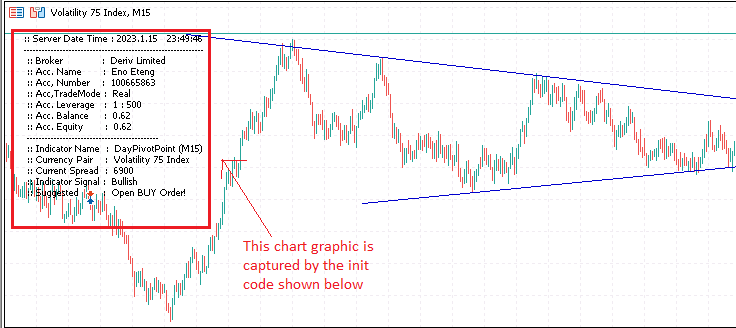
Snapshot of an MT5 chart showing a graphic
//+------------------------------------------------------------------+
//| Custom indicator initialization function                         |
//+------------------------------------------------------------------+
int OnInit()
  {
//--- indicator buffers mapping
   chart_Id=ChartID();
//---
   //--
   font_ohlc=FontsModel(Fonts_Model);
   wind_color=WindColors;
//---
   //--
   iname="DayPivotPoint ("+TF2Str(Period())+")";
   IndicatorSetString(INDICATOR_SHORTNAME,iname+"_("+Symbol()+")");
   IndicatorSetInteger(INDICATOR_DIGITS,Digits());
   //--
   _model=FontsModel(Fonts_Model);
   drawpivot=false;
   drawpohl=false;
   prvtmp=iTime(Symbol(),0,1);
   prvtmo=iTime(Symbol(),0,1);
   //--
   HandleEMA2=iMA(Symbol(),0,2,0,MODE_EMA,PRICE_MEDIAN);
   if(HandleEMA2==INVALID_HANDLE)
     {
       printf("Error creating EMA2 indicator for ",Symbol());
       return(INIT_FAILED);
     }
//---
   return(INIT_SUCCEEDED);
  }
//---------//
Init code of the chart graphic in the MT5 snapshot is shown above
After reading the Init component, the code will check for potential exits on active trades and then look for new entries. If a new entry is identified, it will look at setting a position size according to the proposed risk management principles. The code repeats this process every time the asset forms a new price tick.
When the Forex robot is stopped or reaches its profit target, the Deinit code kicks in. This code could remove the chart graphic or clear a trade count timer.
How to Create a Forex Trading Robot in 3 Steps?
What are the steps to follow when creating your own forex robot? When developing a forex trading robot, it is essential to adopt a stepwise process. You do not just get a programmer to start creating a robot. There are steps you have to follow, and the important ones are done even before actual development takes place.
1. Conduct your initial research
The first step in the process of how to create forex robots is to conduct your research. What does this mean?
You need to identify what strategies will work, scrutinize the idea, and adopt a simple approach to bringing these automated trading systems to life. When we talk of types of trading systems or strategies as part of the initial research, we need to identify what strategy we want to pursue.
- Is the strategy based on market direction, i.e., is it one to follow the up-down movements of the market (trend-following or directional strategies)?
- Is it a market-neutral strategy (used in consolidating or range-bound markets), or is it one based on taking opposing directions on inversely correlated assets (e.g., going long on oil and shorting the Japanese Yen at the same time)?
For currency markets, the strategy commonly used to develop forex trading bots is directional. The Forex bot goes long or short, depending on where the market moves.
Another aspect of research is to check to see if the strategy’s performance will be affected by the elements of fundamental analysis, such as the news or other market microstructural factors. Users of forex trading robots should be aware that there are many sources of market inefficiencies, with the economic news being the number one source of such inefficiencies.
Most of the big moves in the markets are driven by the banks, and this is where attempts are made to align a strategy with those of the big banks. Please note that it is also possible for a forex bot to trade these inefficiencies profitably.
For instance, if an Expert Advisor tracks two currency pairs on different trading platforms and notices a price inefficiency, a forex trading robot can be designed to trade along these lines to deliver profit. Market inefficiency could also be of a technical origin. For instance, the divergence strategy, which deploys momentum indicators, is an example of an attempt to profit from an initial price inefficiency that eventually corrects itself.
2. Scrutinize the Idea for the Strategy
The whole idea of creating a forex bot is for it to be able to identify potential inefficiencies in price that have identifiable causes in a repeated and sustainable manner. The trading idea or strategy must answer the following questions:
- Is it a market-prudent strategy?
- Can it identify persistent points of price inefficiency, and if yes, does the strategy have the ability to identify these price inefficiencies persistently or just a few times?
- Do these price inefficiencies have an identifiable cause?
For instance, if a forex trading bot is built to trade a specific kind of response from a particular news release (e.g., to buy gold if US consumer price index figures are below a specific standard deviation below the consensus number), this is a scenario where the price inefficiency that occurs after the news is released is market-prudent and has an identifiable cause.
It is a market-prudent strategy because it makes sense from an economic/fundamental point of view. It can be persistently done because the US CPI figures follow a monthly schedule and are recurring. The forex trading robot’s response to buy gold if the US consumer price index falls by a minimum of 2 percentage points below the consensus figure would be a quantifiable response.
Similarly, an expert advisor created to identify and trade divergence setups when a momentum indicator is in the overbought or oversold price areas is another example where there is an identifiable cause for the price inefficiency that an EA can exploit on an ongoing and consistent basis. The same goes for when an EA is built to buy into the retracement that occurs in a continuation pattern, such as a flag, pennant, or triangle.
3. Simplicity
Keeping the trading robot’s job as simple as possible is essential. A simple BUY or SELL response, a directional form of trading, works very well for the currency markets. There is no need to try using a robot to conjure complex trade scenarios or trade types as found in the options markets. Remember, the lesson on creating a forex robot is for retail traders and should be simple, inexpensive, and clear.
After performing this three-step process, you are ready with a to create the forex trading robot.
How Do You Write Code for a Forex Trading Robot?
To write code for a forex robot, you must move beyond just knowing the syntax. You need to understand the logic, the specific functions the robot must perform, and the structural blocks required to build it. Here is the process broken down logically.
1. Start with an Algorithm
Before writing a single line of code, you need a plan. Many professionals will tell you that you should never try to solve a problem without first having an algorithm.
- You may know the technicals of how to write the code, but you first need to come up with an algorithm that will guide your programming.
- This algorithm outlines the logic your robot will follow to make decisions.
2. Understand the Robot’s Functionality
Once the algorithm is set, you must understand what the code is actually intended to do on the platform. Unlike a static tool, an Expert Advisor (EA) is dynamic:
- Continuous Analysis: The EA is linked to an asset’s chart and must be able to analyze this chart to automatically generate trades.
- Event Sequences: The code must capture a sequence of events—such as initialization, de-initialization, and changes in market conditions (like volume changes or market depth alterations).
- Repetitive Action: The bot must perform these events not just once, but repeatedly whenever the conditions are fulfilled. This manifests on your front end as long or short orders opening and closing automatically.
3. Get to Work on the Code
When you are ready to write the actual program in MetaTrader (MQL4 or MQL5), the code generally revolves around four essential blocks:
- Syntax: This is where the code for comments, format, and identifiers is input.
- Variables and Datatypes: These are the basic objects that can be assigned a value. They form the foundation on which the EA code is built.
- Expressions and Operations: This includes sequences of operations, operand symbols, or program records where data types characterize values. MetaTrader recognizes seven types of operations.
- Conditionals (If-Else Logic): This code tells the EA to perform a specific function if an expression is executed or fails. In simple terms, it tells the EA: “If not X, then perform Y.”
How Do You Test Your Forex Trading Robot?
Backtesting is one of the ways to test your forex trading robot. To do this, most traders use the Strategy Tester built directly into the MetaTrader platform.
Here is exactly how to configure and run your first test.
Step 1: Open the Strategy Tester
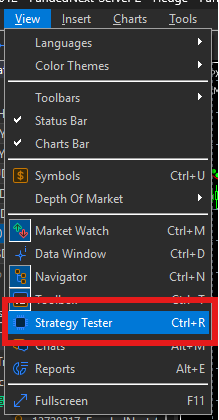
- Launch your MetaTrader (MT4 or MT5) platform.
- Click View in the top menu and select Strategy Tester, or simply press Ctrl + R on your keyboard.
- A panel will appear at the bottom (MT4) or as a new window (MT5).
Step 2: Configure the Testing Parameters
This is where most beginners make mistakes. You must ensure the inputs are realistic to get a valid result. In the “Settings” tab of the Strategy Tester window, you’ll see the following:
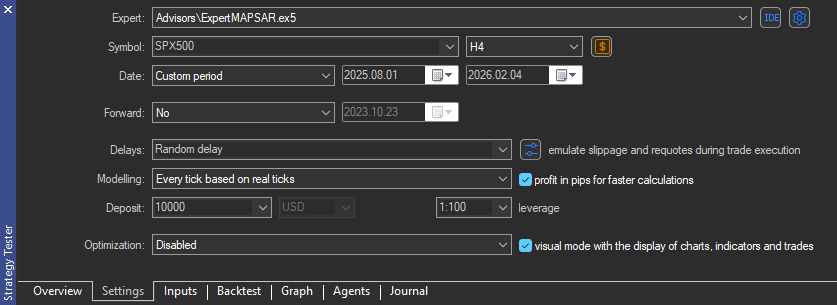
- Expert: Select the specific robot file you just created from the dropdown list.
- Symbol: Choose the currency pair you want to test (e.g., EURUSD).
- Period (Timeframe): Select the chart timeframe your robot is designed for (e.g., H1 for 1-hour, M15 for 15-minute).
- Modelling: Select “Every Tick” (MT4) or “Every tick based on real ticks” (MT5).
- Note: This is the slowest method, but it is the only way to get accurate results. Do not use “Control Points” or “Open prices only” for final testing, as they are not precise enough.
- Spread: In MT4, select “Current” (uses the live spread right now) or manually type in a standard spread (e.g., 10 or 20 points). In MT5, this is handled in the “Delays” section to simulate realistic slippage.
- Date: Check this box and select a start and end date. A valid test usually covers at least 6 to 12 months of historical market data.
3. The “Visual Mode” Check
Before running a long mathematical test, you should run a visual test.
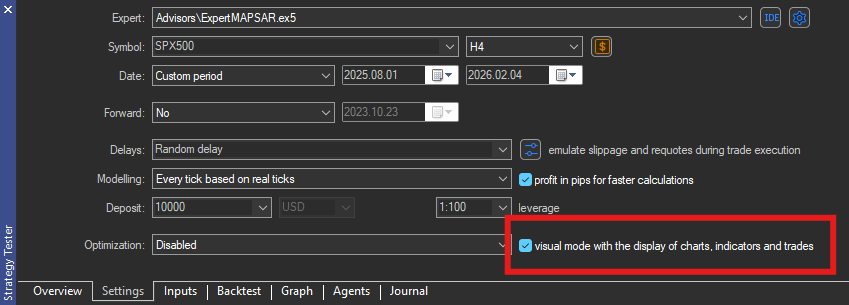
- Check the “Visual Mode” box.
- Click Start.
- What to watch for: A chart will pop up and start moving. Watch the robot place trades. Does it buy when your indicators say buy? Does it place the Stop Loss where you programmed it? If it behaves strangely here, stop the test and fix your code.
4. Run the Full Backtest
Once you confirm the robot behaves correctly in Visual Mode:
- Uncheck “Visual Mode” (this allows the test to run at maximum speed).
- Click Start.
- A green progress bar will load as the computer processes the historical market data.
5. Analyze the Results
When the progress bar finishes and the sound plays, look at the tabs at the bottom of the tester window:
- Max Drawdown: This is the most important risk metric. It tells you the maximum percentage of your account you would have lost at the worst point in the test.
- Graph Tab: This shows your equity curve. A smooth line moving from bottom-left to top-right is the goal.
- Report / Backtest Tab: This contains the raw data. Pay close attention to:
- Total Net Profit: Did it make money?
- Profit Factor: Ideally, this should be above 1.5.
Why Should You Backtest Your Forex Trading Robot?
You should always backtest your forex trading robot because it helps you:
1. Gauge Forex robot accuracy
You check to see if the code and the trades match. You want to see that the code is opening and closing the trades as intended.
2. Understand Forex robot performance
You should be backtesting on every tick. Scrutinize the data to see which price ticks are more relevant to your strategy so that you can tweak the code appropriately.
3. Understand the forex robot market suitability
Understanding your forex robot requires looking at how the robot will perform under different market conditions, time frames, across various assets or currency pairs, and during certain seasons. In other words, you should seek the answers to the following questions:
- Is the robot a better performer in the London or New York time zone?
- Is the trading bot better suited for trading off hourly or long-term time frames?
- What currency pairs or market assets deliver better returns when traded with the Forex robot?
- Is there seasonal performance variation? For instance, does the robot’s performance improve or wane when hurricanes threaten the US Gulf Coast and oil production with attendant effects on oil, the Canadian Dollar, the US Dollar, and correlated assets?
- Are there unexpected events that will impact the Forex bot’s performance?
- Does the robot’s performance in price-efficient conditions ensure the survival of the trader’s account? In other words, does the robot pass tests of risk management?
PS: Before testing your trading bot, you first need to install it on your trading terminal. These guides will be of help:
How to install Forex Trading Robot in MT4
How to install Forex Trading Robot in MT5
What Programming Languages Can I Write Forex Robot Codes In?
As far as the coding for creating trading robots is concerned, the popular languages used are:
- MQL4 (for the MT4 trading platform)
- MQL5 (for the MT5 trading platform)
- C# (for MT5)
- Python (for more complex algorithms)
Other less popular languages are Pinescript (Tradingview) and Lua (TradeStation and NinjaTrader). After coding, you must source and clean up the data for backtesting and optimization.
Whatever language is used, your position sizing must reflect proper risk management. Risks could come from the market (market risk) or from sources outside the market (operational risk), such as poor internet connectivity, counterparty risks, and system failures (if using an overloaded Forex virtual private server).
The Indispensable Role of a Forex VPS for Your Trading Bot
Once you’ve successfully created and optimized your forex trading robot, the next critical step is ensuring it runs flawlessly and continuously. This is where a forex Virtual Private Server (VPS) becomes an essential tool. A forex VPS provides a stable, dedicated, and secure environment, distinct from your personal computer, to host your trading platform and bot. This ensures that your robot operates 24/7 without interruption due to power outages, internet disconnections, or system crashes on your local machine.
For traders using sophisticated platforms like MetaTrader 5 (MT5) to run their automated strategies, hosting your MT5 trading platform on ForexVPS offers numerous advantages. These include ultra-low latency execution, which is crucial for high-frequency trading and rapid market responses, as well as enhanced security for your trading activities. By offloading your trading operations to a specialized Forex VPS, you can confidently let your bot execute trades around the clock, knowing it’s running in an optimized and reliable environment designed for maximum uptime and performance.
Conclusion
Don’t forget. Building a Forex bot is beyond just the lines of code. It involves a lot of research, backtesting, and optimizing. While some traders would rather use no-code trading bot-building websites, know that this won’t give you as much control over your bot as you may need. If you build your bot yourself, however, you can control and determine every single bit of data.uilding websites, know that this won’t give you as much control over your bot as you may need. If you build your bot yourself, however, you can control and determine every single bit of data.